
A tiny lens box can carry more information than most people realize. When you are comparing nearly identical cases in a bathroom drawer, contact lens symbols explained in plain language can prevent a frustrating mix-up. The letters and numbers on a blister pack or carton tell you which lens belongs to which eye, how it fits, how it corrects vision, and when it should no longer be used.
The challenge is that the details are easy to lose when the outer box gets tossed. That is especially true for people who wear more than one prescription, keep backup lenses, or switch between clear and colored contacts. Knowing what each mark means gives you a simple system for labeling, storing, and replacing lenses with less guesswork.
Contact Lens Symbols Explained: Start With the Prescription
Most lens packaging uses abbreviations rather than full words. These are not decoration. They are the specifications your eye care professional used to match a lens to your eye and vision needs. Read the information on the box and the individual blister pack, but remember that the prescription provided by your eye care professional is the final reference.
PWR, SPH, or Power
PWR and SPH both refer to lens power, measured in diopters. This is the number with a plus or minus sign, such as -2.50 or +1.75. A minus sign generally corrects nearsightedness, while a plus sign generally corrects farsightedness.
This number may differ between your right and left eye. If two lens cases look the same but one eye uses -2.25 and the other uses -2.75, swapping them can leave your vision slightly blurred and make the mix-up harder to notice. Record the power for each eye rather than relying on memory.
BC Means Base Curve
BC stands for base curve. It describes the curvature of the back surface of the lens, usually shown as a number such as 8.4, 8.6, or 8.7. The right base curve helps a lens sit correctly on your eye.
A base curve is not a size preference you should select casually. Two lenses can have the same power and look alike in the package but have different base curves. Follow the brand and specifications your eye care professional prescribed, particularly when replacing lenses with a different product.
DIA Means Diameter
DIA is the lens diameter, measured in millimeters. Common soft contact lens diameters are around 14.0 to 14.5 mm, though cosmetic and specialty lenses may be different. Diameter works with base curve to determine how the lens covers and centers on the eye.
For colored contacts, diameter can affect the appearance of the color pattern as well as the fit. Keep the diameter written down with the color name so a favorite shade is not mistaken for another lens that happens to come in a similar-looking case.
CYL and AX Are for Astigmatism
If you wear toric lenses for astigmatism, your packaging may also show CYL and AX, or axis. CYL refers to the amount of astigmatism correction. AX is a number from 1 to 180 that indicates the orientation of that correction.
These details make it especially important not to combine lenses from different boxes. A lens may have the same power as another pair but a different cylinder or axis. It can still feel wrong and provide unclear vision. Store the complete set of prescription details together: PWR, BC, DIA, CYL, and AX.
ADD May Appear on Multifocal Lenses
ADD means additional near-vision power. It is commonly found on multifocal contact lenses and may be labeled low, medium, high, or shown as a number. Some multifocal packaging also includes a design label such as distance, near, or center-near.
Do not assume that two multifocal boxes are interchangeable because their main power matches. The ADD level and lens design matter. Keep that information with the case so you know exactly what you are wearing.
Right, Left, and Other Identification Marks
Look for OD and OS on prescriptions, invoices, or sometimes product labels. OD means the right eye, and OS means the left eye. You may also see R and L. If both eyes have the same prescription, it is still useful to identify a consistent right and left case. That routine reduces accidental switching after cleaning or replacing lenses.
Some packages include a small diagram showing which side of a toric lens should orient in a certain direction. This is not the same as a right-versus-left label. It helps the lens settle into its intended position on the eye. If your lenses repeatedly rotate, feel uncomfortable, or deliver inconsistent vision, contact your eye care professional instead of trying to solve the issue by changing the label system.
Dates and Packaging Symbols That Affect Lens Safety
Prescription numbers tell you what the lens is. Date and packaging symbols tell you whether it is still appropriate to use. These marks deserve the same attention as PWR or BC.
EXP or the Hourglass Date Symbol
EXP means expiration date. On some medical-device packaging, the date is paired with an hourglass-like symbol that means use by. It applies to the unopened, sealed lens package. Do not use a lens from a blister pack that is past its stated expiration date, even if the pack looks normal.
The expiration date is different from your replacement schedule. A box might not expire for years, while the lenses inside may be daily, biweekly, or monthly lenses once opened. Write down both dates: the package expiration and the date you opened a lens.
LOT or Batch Code
LOT identifies the manufacturing batch. It can be helpful if a manufacturer or retailer needs to identify a specific product batch. It is not your prescription, and it does not tell you when to replace an opened lens.
Keep the lot number with the original box or take a clear photo before discarding packaging. You may never need it, but it is useful information to have if you need to ask a question about a lens.
Sterile, Single-Use, and Read-the-Information Symbols
A symbol with the word STERILE indicates the lens was sterilized in its unopened package. If a blister pack is leaking, torn, cloudy, or damaged, do not wear the lens. Sterility depends on that sealed package remaining intact.
A symbol showing the number 2 with a line through it may indicate single use or that the package should not be reused. A small open-book symbol means to consult the instructions for use. These symbols can vary by manufacturer, so the package insert is the best place to confirm the meaning for your specific lenses.
Do not confuse a daily disposable lens with a lens that can be stored overnight in solution. A daily disposable lens is discarded after one day of wear. Reusable lenses must be cleaned, disinfected, and stored according to the instructions from the manufacturer and your eye care professional.
Colored Contact Lens Labels Need Their Own Record
Colored contacts can make organization more confusing because the prescription information may be identical across several pairs. The difference is often the color name, pattern, or collection name printed in smaller text on the box.
Record the brand, color name, power, BC, DIA, expiration date, and replacement schedule. If a color is available in both plano and prescription versions, make sure the power is part of the label. Plano means zero corrective power, but it does not mean the lens can be worn without professional guidance. Decorative contacts are medical devices and should be properly fitted and prescribed.
A color-coded storage system is useful, but color alone should never be the only identifier. Two blue lenses can have different prescriptions, expiration dates, or replacement schedules. Pair a visual cue with the actual product details.
Turn Package Details Into a Simple Lens Organization System
The most reliable time to capture lens information is when you open a new box. Do not wait until the carton is empty, the blister packs are separated, or you cannot remember which shade was which.
For each pair, keep these details together:
- Right or left eye designation
- PWR or SPH, plus BC and DIA
- CYL, AX, and ADD when applicable
- Brand and lens type
- Color name for cosmetic lenses
- Box expiration date and opened-on date
- Replacement schedule and purchase details
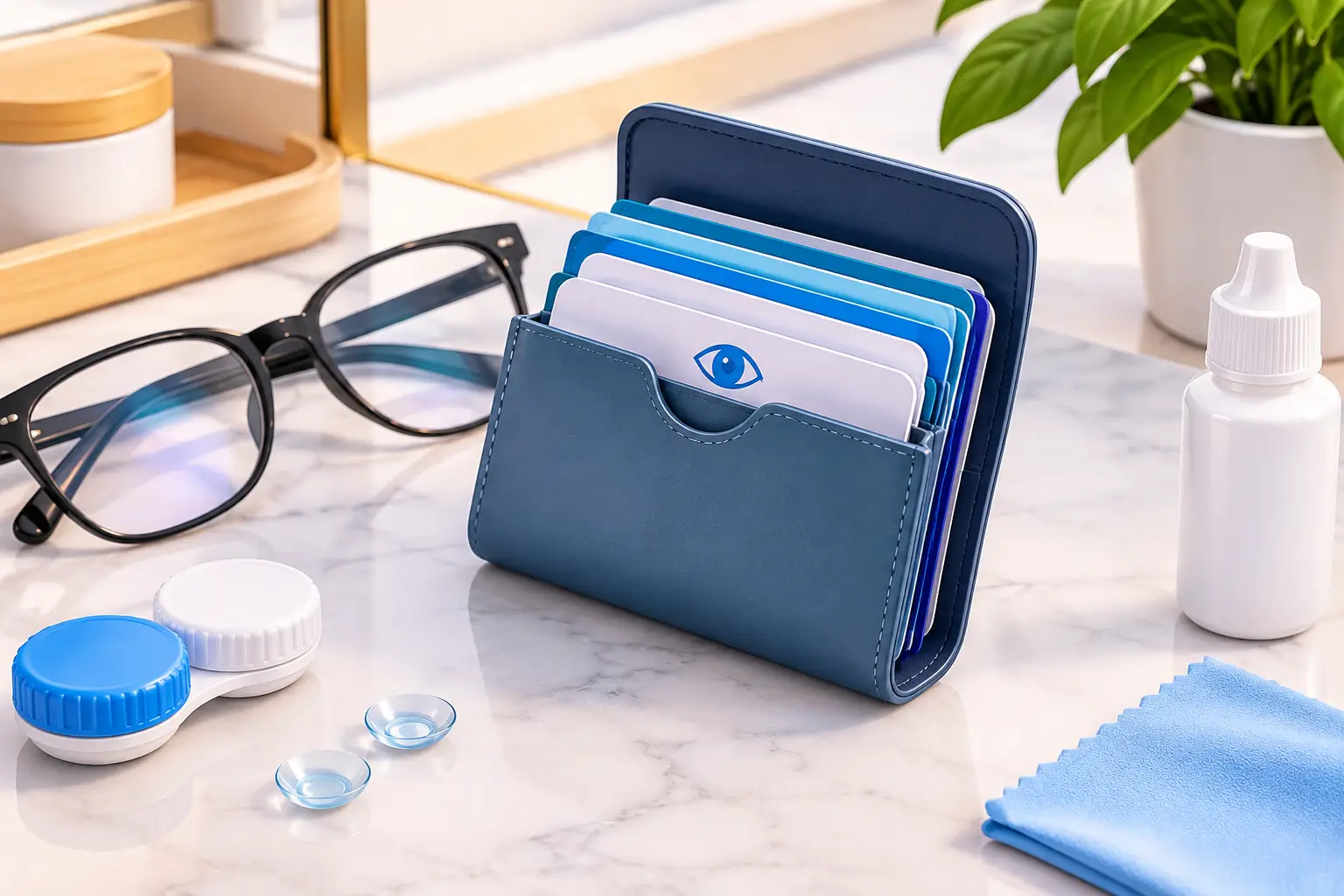
This takes a minute at the start and saves repeated checking later. A purpose-built organizer such as EYEBOX can keep lens cases alongside the information that identifies them, rather than leaving crucial details on discarded cartons or loose notes. The goal is not to create a complicated tracking project. It is to make the correct lens easy to identify every time you reach for it.
When the Symbols Do Not Match What You Expected
Packaging can change when a manufacturer updates its design, and abbreviations may be placed in different spots on the carton. Still, the core specifications should match your prescription and the product you intended to purchase. Check the power, base curve, diameter, and any astigmatism or multifocal details before opening a box.
If the numbers do not match, the lens color is not what you ordered, the package is damaged, or your vision feels off, set the lenses aside. Do not try to make a different lens work because it is close to your usual prescription. Your eye care professional or seller can help verify the product.
A clear label is a small part of lens care, but it changes the everyday routine. When every case has its matching prescription, color, dates, and purchase details nearby, you spend less time decoding tiny print and more time feeling certain about what goes in your eyes.