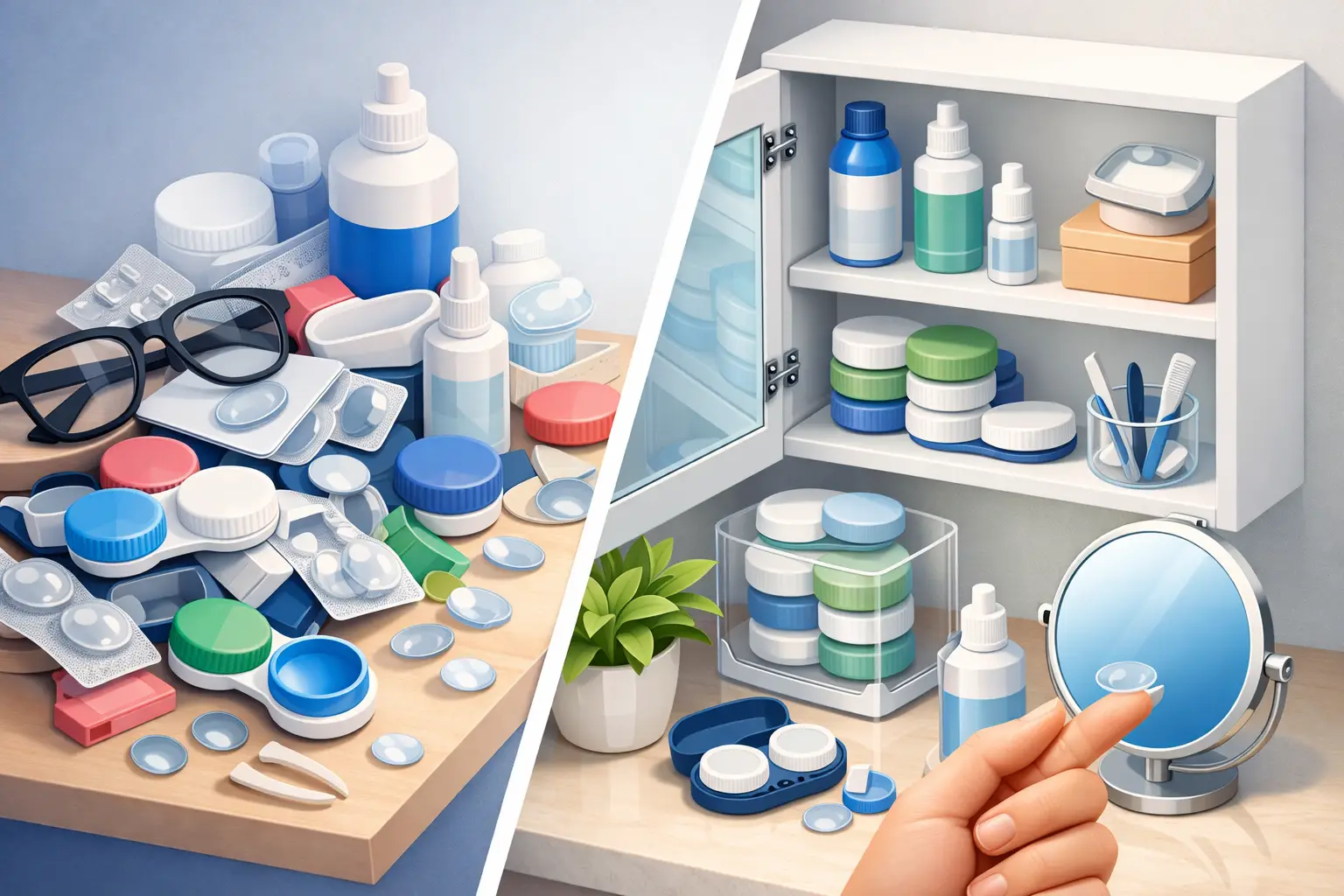
A contact lens drawer can look fine until you need one specific pair. Then there are loose cases, faded boxes, solution bottles, old blister packs, and several lenses that look almost identical. To reduce contact lens clutter, you need more than a quick cleanup. You need a simple way to keep each pair connected to the details that tell you what it is and whether it is still usable.
That matters even more when you wear prescription lenses, colored contacts, or more than one type of lens. A case alone does not tell you the prescription, color, purchase date, or replacement schedule. Once the original packaging is gone, those details are easy to forget.
Why contact lens clutter causes real problems
Lens clutter is rarely caused by having too much stuff. It usually happens because the information is separated from the lens case. The box goes in the trash, the prescription lives in an email, and the case ends up in a bathroom drawer with other similar cases.
The result is a frustrating guessing game. Is this the right power? Was this pair bought last month or last year? Is the blue case holding clear lenses or colored ones? Even if you eventually figure it out, the process adds unnecessary friction to a routine that should take seconds.
Clutter can also lead to wasted lenses and duplicate purchases. If you cannot tell which pairs you already have, you may replace lenses you did not need to buy. If you cannot locate the correct information, you may set aside a perfectly good pair simply because you no longer trust what it is.
The goal is not to keep every piece of contact lens packaging. It is to keep the details you actually need in one reliable place.
Start by sorting lenses into active and inactive groups
Begin with every lens case, lens box, and unopened package you currently have. Put them on a clean, dry surface so you can see the full picture. This step is useful because it separates what you use from what has simply been sitting in a drawer.
Your active group should include lenses you are currently wearing, lenses you plan to start soon, and unopened backups you know you will use. Your inactive group may include empty packaging, old cases, products you no longer wear, and anything you cannot identify with confidence.
Do not make assumptions about unidentified lenses. If a case is not clearly labeled and you cannot confirm its prescription, color, or timeline, it is better not to guess. Contact lenses sit directly on your eyes, so uncertainty is not something to organize around.
Once you have sorted the group, discard empty boxes and packaging only after recording the details you need. Then remove expired products or cases that are worn, cracked, or no longer appropriate to use according to the guidance from your eye care professional and the product instructions.
Record the details that prevent mix-ups
A tidy drawer is helpful, but a tidy drawer without information can still create confusion. For each active pair, record the details that help you identify it at a glance. At minimum, keep track of:
- Prescription or lens parameters
- Lens color or style, if applicable
- Purchase date and replacement schedule
- Expiration date and where the lenses were purchased
For prescription wearers, this can prevent the common mistake of mixing up similar powers. For colored contact lens users, the color name is especially useful. Brown, hazel, gray, and blue lenses can look surprisingly alike when they are stored in cases instead of their original boxes.
It also helps to write down whether a pair is daily, biweekly, monthly, or another replacement type. The purchase date is not always the same as the date you opened a pair, so use the record that makes the most sense for how you manage your lenses. If you open multiple pairs at different times, note the opening date too.
Create one home for every active lens pair
The fastest way to bring order to your lens routine is to stop storing contact lens items in multiple places. A bathroom cabinet, makeup bag, bedside drawer, and medicine cabinet may all seem convenient, but scattered storage makes it harder to see what you own and easier to lose important information.
Choose one designated home area for your active lens cases and their records. The best setup keeps each case in a defined spot, rather than allowing cases to roll around loose. It should also let you connect the physical case with its prescription, color, expiration date, and purchase information.
This is the purpose behind EYEBOX®, a compact organizer designed to store contact lens cases while keeping key lens details together. Instead of relying on memory or saving a stack of mismatched cartons, you can create a clear record for each pair where you store it.
A purpose-built system is particularly useful if your household has more than one contact lens wearer. Give each person a separate organizer or clearly defined section. Sharing a general drawer may save space, but it increases the chance of grabbing the wrong case or losing track of whose lenses are whose.
Use a simple labeling system you will keep up with
The best organization system is not the most complicated one. It is the one you will actually use after a long day. Labels should be easy to read and consistent from one pair to the next.
Start with the identifying detail that matters most to you. For many people, that is prescription strength. For cosmetic lens wearers, it may be the color name. Add a second detail if needed, such as the month opened or replacement date.
Color-coding can make this even easier. You might assign one color to everyday prescription lenses, another to colored contacts, and another to unopened backups. The point is not to create a perfect filing system. The point is to recognize each category before you have to open a case or search through old packaging.
If you have right and left lenses with different prescriptions, make that distinction obvious. A small mix-up can create a large inconvenience, especially when you are getting ready in the morning. Keep the same order every time, such as right lens information first and left lens information second.
Keep backups visible, but separate
Unopened backup lenses should not be buried behind active cases. When backups disappear in the back of a drawer, it is easy to buy more before checking what you already have. At the same time, backups should not be mixed with lenses you have already opened.
Give unopened products their own section and arrange them by expiration date. Put the sooner-to-expire items where you will see them first. This is a small habit that can help you use what you have before it becomes outdated.
There is one trade-off: keeping every backup in plain sight can make a small space feel crowded. If storage is limited, keep only the next few pairs with your daily supplies and place longer-term inventory in a separate, clearly labeled area. What matters is that you still have one record of what is there.
Build a five-minute lens reset into your routine
Contact lens clutter returns when a system is never updated. Fortunately, you do not need a major cleanup every week. A quick reset when you open a new pair or finish an old one is usually enough.
When you start a new pair, add or update its information immediately. When you finish a pair, remove the empty case and any record you no longer need. If you buy backups, add the purchase details before the box gets separated from the lenses.
A monthly check is also useful for spotting products that are nearing expiration, cases that need replacement, or details that are no longer readable. Think of it as maintenance, not a project. Five minutes now can prevent the drawer from becoming a pile of mystery cases later.
A cleaner setup makes the routine easier
Reducing clutter is not about making your contact lens supplies look picture-perfect. It is about making the right pair easy to find, easy to identify, and easier to manage with confidence. When each case has a place and every lens has its details attached, you spend less time searching and less time second-guessing.
Start with the cases you use this week. Record their information, give them a dedicated spot, and remove the items that no longer serve a purpose. That one small reset can turn an everyday source of frustration into a routine that feels clear and under control.