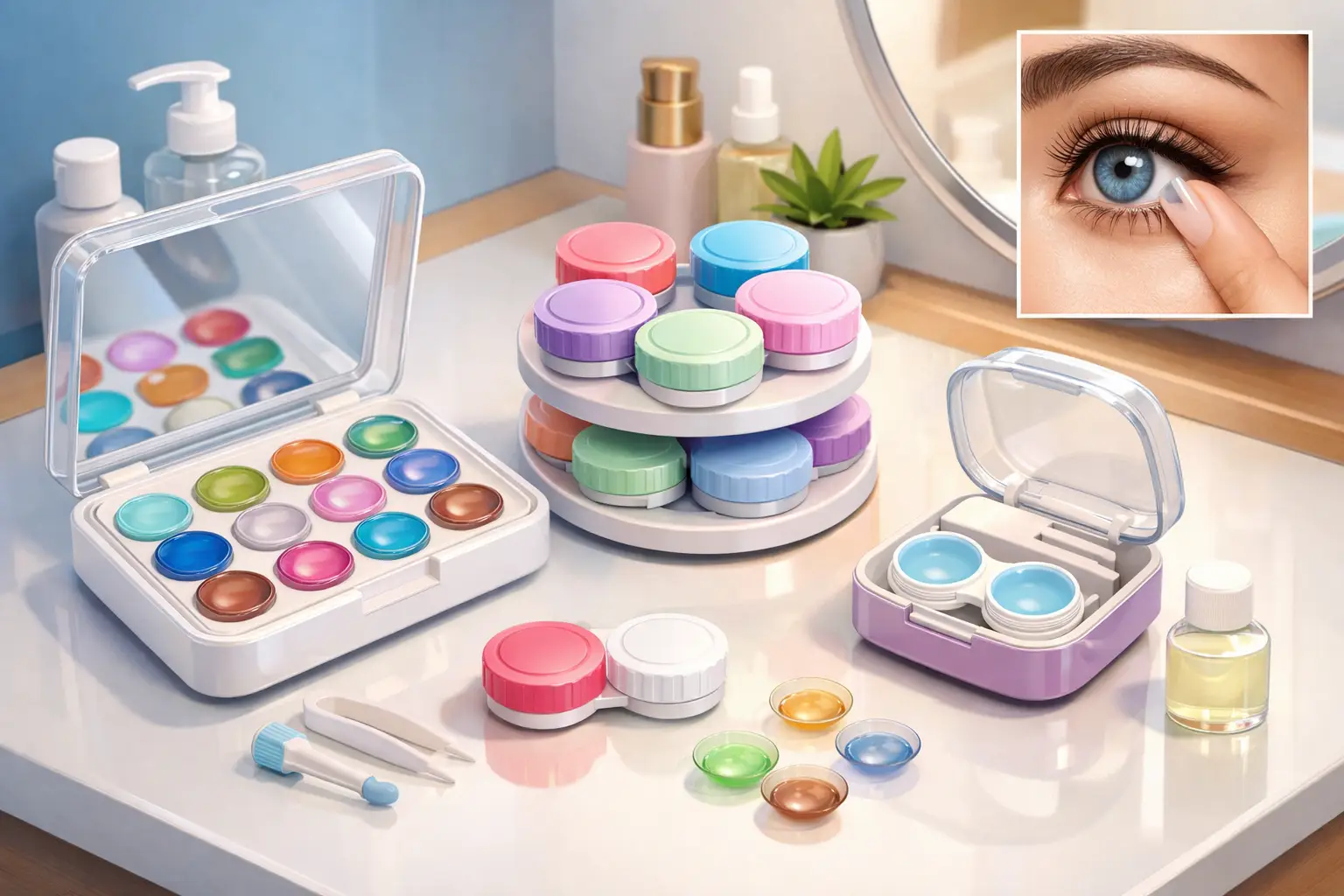
If you wear more than one pair of colored contacts, you already know how fast the routine gets messy. Two nearly identical lens cases, one missing box, and one forgotten expiration date are usually all it takes to turn a simple morning into guesswork. The best way to organize colored contacts is to keep each pair stored with its color, prescription, purchase details, and replacement timeline in one dedicated system.
That sounds simple because it should be. The problem is that most people are not dealing with just one pair. They may have natural brown-enhancing lenses for daily wear, a gray pair for going out, and prescription contacts that need to stay separate from cosmetic ones. Once the original packaging is tossed or the labels wear off, everything starts to look the same.
A good organization method does more than make your bathroom drawer look better. It helps you avoid mix-ups, keeps replacement schedules clear, and gives you a quick way to confirm what you are actually wearing. When you are putting something directly in your eyes, that kind of clarity matters.
What makes the best way to organize colored contacts work
The best systems all do the same three things. They separate each pair physically, preserve the details that usually get lost, and make it easy to identify the right lenses at a glance.
A loose collection of lens cases in a drawer does none of that well. It may feel manageable when you only have one or two pairs, but once you rotate between different colors or prescriptions, the weak spots show up quickly. You forget which pair was opened first. You cannot remember whether the blue pair is plano or prescription. You know one set expires soon, but not which one.
That is why the best way to organize colored contacts is not just about storage. It is about storage plus information. If those two things are separated, the system usually fails.
Why colored contacts are harder to organize than regular lenses
Colored contacts create a very specific type of clutter. With clear corrective lenses, you are usually tracking one prescription and one replacement cycle. With colored lenses, you may be tracking multiple colors, occasional wear, different brands, and different use cases.
Some people wear colored contacts only on weekends. Others rotate them based on makeup, events, or season. That means one pair may be used often while another sits for weeks. Without a clear system, it becomes much harder to remember when a pair was opened and how long it has actually been in rotation.
There is also the packaging problem. The box often holds the most useful details, including base curve, power, brand, and expiration date. But boxes are bulky, easy to toss, and rarely stored in a way that helps with daily use. Once they are gone, you are left trying to remember details from memory, which is not a great plan for lens care.
A practical system for organizing colored contacts
The most effective setup is simple. Give every pair its own place, and keep the identifying information attached to that place instead of relying on the lens case alone.
Start by separating your lenses by pair, not by brand or by where you bought them. Each pair should have its own clearly assigned case or compartment. Then record the details that matter most: color name, prescription strength if applicable, purchase date, open date, and expiration date. If you wear both cosmetic and prescription lenses, note that clearly too.
This is where many homegrown systems fall apart. Sticky notes get lost. Marker labels fade. Notes on your phone help only if you remember to update them. A better option is a dedicated organizer built around how contact lens users actually behave. That means the lenses are stored neatly, and the information stays with them instead of floating around separately.
For people who keep multiple colored contacts in rotation, a purpose-built organizer like EYEBOX makes a lot more sense than a random drawer setup. It gives each pair a designated place while preserving the details users most often lose track of, including color, prescription, expiration date, and purchase information. That removes the usual friction from the routine.
The details you should always track
Not every lens detail matters equally in daily life, but a few are worth keeping in front of you.
Color is the obvious one, especially if the names are similar or the shades are subtle. “Hazel Glow” and “Honey Brown” may not be easy to tell apart from memory once the boxes are gone.
Prescription is just as important. If some of your colored contacts are cosmetic only and others include vision correction, a mix-up can affect more than appearance. You want to know exactly which pair does what.
Open date and expiration date are where organization becomes a health and money issue. A forgotten pair can sit longer than intended, while a newer pair gets opened unnecessarily because the older one cannot be identified. Good organization helps you use what you have correctly and replace it on time.
Purchase details are useful too. If you need to reorder a shade that worked well for you, having the brand and timing written down saves a lot of frustration.
Common organization mistakes that cause mix-ups
The biggest mistake is assuming you will remember. Most people do remember at first. Then a few weeks pass, the cases shift around, and the details blur.
Another common problem is using lens case color as the only identifier. That can work for a short time, but it breaks down once cases get swapped, replaced, or cleaned out. Case color is a weak label when compared with a system that records the actual lens information.
Keeping unopened boxes in one place and used lenses in another is also less helpful than it sounds. It creates a split system where the lens and the details are separated. Every time you need to confirm something, you have to hunt in two places.
And then there is the catch-all drawer. It feels convenient until you are trying to figure out which pair is still current and which one you meant to stop using last month. Convenience without structure usually turns into repeated small mistakes.
How to keep your system easy to maintain
The best organization method is the one you will actually keep using. That means it should take only a few seconds to update when you open a new pair or retire an old one.
Try to set up your system around the moments when lens confusion usually happens. For most people, that is when opening a fresh pair, switching between colors, or cleaning out the bathroom area. If your method makes those moments easier, you are more likely to stick with it.
It also helps to keep everything in one main storage location instead of spreading lens cases, solution, and leftover packaging across multiple spots. The more scattered the routine becomes, the easier it is to lose information.
A clean layout changes the experience in a noticeable way. Instead of checking three places and making your best guess, you can look once and know what you have, what you are using, and what needs replacing soon.
Best way to organize colored contacts if you wear them often
If colored contacts are part of your regular routine, not just occasional wear, your setup needs to handle repeat use without creating confusion. That means your organizer should support quick visual identification and clear record keeping at the same time.
Frequent wearers benefit from a system that makes rotation obvious. You should be able to tell which pair is active, which pair is backup, and which pair is nearing its replacement point. That is harder to do with a pile of similar cases and much easier with assigned storage spaces and written details.
This is also where consistency matters more than perfection. You do not need a complicated spreadsheet. You need a reliable way to match each pair with its actual information every single time.
When a simple case is enough and when it is not
If you own one pair of colored contacts and use them rarely, a standard labeled case may be enough for now. The trade-off is that you still need a dependable way to keep the lens details from getting lost.
But once you have multiple colors, mixed prescriptions, or ongoing reorders, a simple case stops being enough. At that point, the problem is not where the lenses sit. The problem is that the information around them keeps disappearing.
That is usually the line between feeling organized and actually being organized. Real organization gives you control over both the product and the details that come with it.
Colored contacts should be fun to wear, not one more thing to second-guess. Build a system that lets you find the right pair, confirm the right details, and move on with your day.